Tag Archives: Medicine

Posts that relate to medicine in some way.

We do NOT want to cut your beautiful baby boy!

IMG_5505Dear Dr Pate,

I’m a third-year medical student who is strongly considering going into OBGYN. Unfortunately, I’ve been really dismayed to discover how common it is for OBGYN residency programs to require their residents to perform circumcisions. I’ve begun to worry that my moral opposition to circumcision might be incompatible with going into OBGYN. I don’t want to get into a situation where I might be fired if I don’t perform circumcisions because I would rather get fired–and if that’s the case then why go into that field in the first place. I started to google about the topic and your blog was one of the first to come up.

Do you have any advice for a student in my situation? Should I try to seek out OBGYN residency programs that don’t require residents to circumcise? Should I just match into OBGYN and then refuse once I already have the job (can I be fired for that?).

Thanks,
MS3


Dear MS3,

Thanks for writing! I find it so refreshing to hear more and more from students, such as yourself, who desire to refrain from performing circumcision. Clearly you are not alone but tradition is deeply engrained in culture and deviation therefrom is considered illogical and threatening. If you are interested in OB/GYN, don’t worry about circumcisions. I wouldn’t even bother mentioning it in your interviews — it falls under the same legal protection as beliefs about abortion.

I encourage you to check out my post — Do medical students have to assist circumcisions? There are links to resources available to you. Hold you head high! Where there is a will there is a way. You don’t have to compromise yourself.

Some will tell you that refraining will limit your career opportunities. It is true that some jobs will try to push you. You can take either approach — put it out there so that potential problems will fall away before you become too invested or discuss it after the fact and assert your rights.

I chose to be proud and loud throughout my process; I stirred controversy and rocked the boat. This did result in expected consequences and more than a few blows to my ego however it was the right path for me. At least one attending physician and another resident refuse to do circumcisions because of my example. And that, for me, made the pain and suffering worth it.

And I have not been pushed aside by all employers as I was warned. One recruiter even told me that I didn’t have a chance landing a job in a major city. I dropped him like a rock. Instead I have joined a phenomenal group practice in a very coveted location just 20 minutes north of Manhattan.

So my advice to you is this: Follow the path that feels right for you and do not fear the obstacles that you will find. Be true to yourself and work hard and your path will continue to unfold before you. Keep your eyes on that path and drop the rocks!

Sincerely,
James Pate, MD
http://JamesPateMD.com

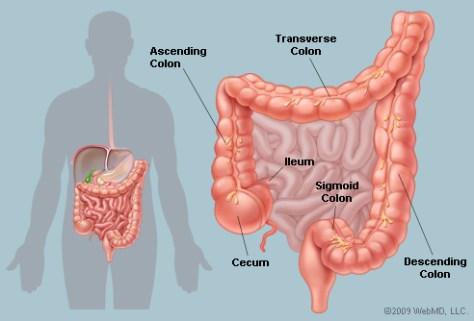
What do you know about colon cancer screening?

  • Colon cancer is the 3rd most common cancer diagnosed in women.
  • It is also the 3rd leading cause of cancer death.
  • The American Congress of Obstetricians and Gynecologists (ACOG) recommends that women without known risk factors begin screening at age 50.
  • The screening method with the best detection rate is colonoscopy every 10 years.
  • Women with African ancestry should begin screening at age 45.
  • Screening should begin:
    • At age 40 if:
      • A biological parent had either a colon polyp or colon cancer before age 60.
      • 2 or more biological parents or children had polyps or cancer at any age.
    • 10 years earlier than the age a biological parent was diagnosed with colon cancer. (If a parent was diagnosed with colon cancer at age 40, screening should begin at age 30).
    • Within 8 years following diagnosis of inflammatory bowel disease (ie ulcerative colitis or Crohn disease).
    • At age 21 in individuals with a family history of hereditary nonpolyposis colon cancer (HNPCC). They should also consider genetic counseling and testing.
    • At puberty in individuals with a family history of familial ademomatous polyposis (FAP). They should also consider genetic counseling and testing.

Care of the prematurely retracted foreskin

Dear Dr Pate,

I’ve read some of your (awesome) posts and have a random question I’m hoping you can answer! 🙂 I know of a mom whose son was forcibly retracted when he was 7 months old. Unfortunately, she was told that after that point, she needed to continue doing it, which she did for another year following that incident. Now she knows that was wrong. The problem is that he’s fully retractible now (even though not “naturally” so), and she doesn’t know if she should continue asking him to retract himself to clean it (as she would a naturally retractible child), or not. He’s only 2 years old, and resistant to doing so. I’m inclined to say leave it alone and that just soaking in the bath will be good enough, but wanted to double-check. If he doesn’t retract to clean, would it encourage adhesions or infection?


Dear KD,

Thank you for your kind comments and your excellent question! I am inclined to tell her to leave it alone as well given that kiddos do not have the same amount of body secretions as teens and adults. Likewise, I can’t image that other cultures around the world pay even a 10th of the interest in either the excision or maintenance of the foreskin as we do in the U.S. Do little girls really need to be taught anything more to wash briefly in the tub? The same should apply to little boys. However, I am not a pediatrician so I asked my colleagues for their opinions which follow below. Best of luck to the little tyke and thanks again for writing.

Sincerely,

James Pate, MD
http://jamespatemd.com


I agree with you and would have advised the same. If he is resistant to retraction, I would leave it alone. It may re-adhere, but I would imagine that it will detach over time without undue intervention despite the earlier forcible retraction. If not, he can use steroid cream if indicated. I don’t see it becoming infected.

On the other hand he may become more amenable to retraction and cleaning in the coming months which would make it a non-issue. He may be objecting because he’s two years old. But I see no reason to compel him to do something he doesn’t want to do at this time.
―Dr Paula Brinkley, pediatrician


I just wanted to assure you that your advice was just right! We need not retract the eyelid to wash under it, and mucous membrane will keep adjacent tissues from adhering one to the other. In most non-circumcising countries, from what men have told me, they often are taught little and generally figure out hygiene on their own. If they are told something, it’s usually around puberty, probably when secondary sex hormones are produced.

We don’t teach girls to pull their prepuce back to wash under it and we don’t put Q-tips or anything else into their vaginas to wash them. The body is self-cleaning. And, little boys need a normal sense of unconcerned boyhood. The baby’s objections to having his foreskin messed with is the message to which everyone should listen.

There are three great articles that you might find helpful at http://www.nocirc.org/articles. They are:

―Marilyn Milos, RN, Executive Director, National Organization of Circumcision Information Resource Centers (NOCIRC)


In my opinion, you don’t have to be a pediatrician to answer this question – most pediatricians don’t know anything about taking care of the foreskin anyway! – so I’m going to offer my own take on this.

There are no controlled studies on correct care of the intact penis, so the best we have to go on is a good understanding of the structure and development of the foreskin, plus common sense.

The few studies that I know of that looked at retractability, foreskin hygiene, and outcomes are so methodologically problematic and ignorant of the natural development of the foreskin as to be completely worthless guides (Kalcev 1964, Krueger and Osborn, 1986).

Most of the “literature” on care of the intact penis are merely opinion pieces. One would hope that this “opinion” would be based on a solid knowledge of the development of the intact penis, and/or extensive experience in conservative care of the intact penis, but unfortunately this is not the case, as we all know, and there is a lot of mistaken and potentially harmful advice given.

“I did an inservice on care of the intact penis 6+ years ago where I dug up as much literature on it as I could (17 articles, 2 of which were from CIRP and NOCIRC). I am attaching a summary of some of the advice from these handouts that I posted at Mothering.com some years back, plus some additional quotes that support the idea of “leave it alone”.

Here’s the general consensus from these handouts:

  • If the FS is non-retractable, no matter how old the boy is, all that need be done is to wash off the outside. PERIOD.
  • Once the FS is retractable AND the boy is developmentally able (generally have the motor dexterity and ability to follow instructions by about age 4-5), he can be taught to retract, rinse, replace. [Note, this makes the idea of requesting a 2 year old to retract and clean himself seem pretty pointless.]

Sources that specifically mention frequency suggest:

  • In childhood: this rinsing might be done say only “occasionally”
  • By puberty: more “regular”, or “daily” rinsing is suggested

Although some older articles will recommend that parents retract the child (based, I believe on a preconception of the foreskin as problematic, and ignorance of the natural development of the intact penis), most do NOT say this, and a number do support the idea of leaving it alone (see my Mothering post attachment). In fact there is one great quote from Canadian pediatric urologist Peter Anderson stating that “there’s no evidence there’s any need to clean under the foreskin before puberty.”

Remember that the foreskin is designed to keep the ooky stuff out (tight outlet in childhood, sphincter-like action of the peripenic muscle), and that it is flushed outward multiple times a day with sterile urine, thus keeping itself clean.

As a John Geisheker likes to point out, “Our primate predecessors were unlikely to head down to a nearby river every day to scrub their children’s genitals. Nature would quickly eliminate those who needed such care. Only those tough enough to not require genital cleansing would have survived. We are those survivors. … Mid-19th century English-speaking boys and girls did not suddenly require aggressive genital hygiene when their ancestors, for hundreds of generations, survived nicely on benign neglect.”

If this 2-year-old is resistant to having his foreskin retracted, by all means, leave it alone! It is unnecessary from a hygiene point of view, and could be more psychologically distressing than its worth. He will discover the joys of retracting himself when he’s ready and interested himself. In the meantime, it is quite possible that just playing with his penis in clean tub water might be all the cleaning needed. Since the average age to full retractability is somewhere are age 10, I would encourage this young mom to sit back, respect her son’s own time table and emotional boundaries, and just let nature take its course.

―Gillian Longley RN, BSN, MSS, Colorado NOCIRC


Rather than re-invent the wheel and write a longish, potentially unwelcome, or over-obvious email, I am attaching several articles we at DOC wrote for Psychology Today magazine on this very issue.

The short answer, (which I suspect you know instinctively), is that urine is sterile and the boy-child is ‘washed’ at each urination. The notion that intact (not C’d) boys need special hygiene is an invented one of Anglophone origin, its sources easily traced to the mid 19th century, a time of great anxiety about masturbation (even among toddlers) as a source of disease. This was before Koch (1879) and others identified pathogens.

In evolutionary terms, the notion that boys need special genital hygiene makes no sense. Our primate ancestors were likely far more concerned with foraging for food and finding a safe place to sleep each night. There was no time or motive to scrub the genitalia of their offspring (and my primatologist neighbor tells me no such behavior has ever been seen in the wild).

We are their descendants who never needed any such care. The infant vulva and infant penis, like the infant eyes and mouth, are self-defending and self-cleaning. It could hardly be otherwise.

―John V. Geisheker, J.D., LL.M. Executive Director, General Counsel, Doctors Opposing Circumcision (D.O.C.)


Considering circumcision?

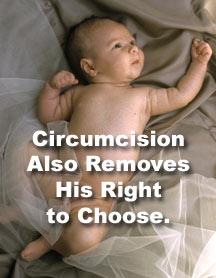
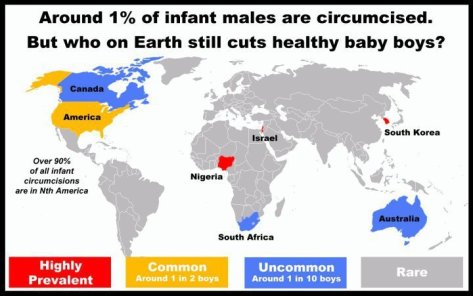
Circumcision has been a “traditional” procedure in the U.S. for many decades. However, more and more parents are choosing to leave their sons intact in spite of  a great deal of pressure from other family members and/or religious leaders to follow their traditions. Why do these parents refuse? What’s the big deal?

sticker1

Well I could tell you, “Go ahead! It’s just a little skin,” and pad my wallet with the extra money I could make from these “simple” procedures. Or I can speak to you as a father who regrets his decision to have his son circumcised and try to provide you with the information you should know before making this life-altering decision for your son(s).

I have written multiple posts on this subject and am what is known as an “intactivist” — an activist for the preservation of intact genitalia for all minors unless medical necessity (not preference) dictates otherwise. However, that is not the point of this post. I simply desire to give you information so that your decision, whichever it may be, may be fully informed.

choice

If you are interested in finding out more about circumcision I highly recommend the following resources:

Finally, if you are just nervous about how to care for an intact penis, it’s much easier than you think. Check out the following pamphlets on how to care for your infant son and what to expect as he ages.

clean

Ob-Gyns: Prepare to Treat Transgender Patients

Ob-Gyns: Prepare to Treat Transgender Patients
November 21, 2011
From: The American College of Obstetricians and Gynecologists

Washington, DC — To address the significant health care disparities of transgender individuals and to improve their access to care, ob-gyns should prepare to provide routine treatment and screening or refer them to other physicians, according to The American College of Obstetricians and Gynecologists (The College). In a Committee Opinion published today, The College also states its opposition to gender identity discrimination and supports both public and private health insurance coverage for gender identity disorder treatment.

Although the total number of transgender people in the US is unknown, studies suggest they make up a small, though substantial, population. Transgender is a broad umbrella term that includes people whose gender identity and/or gender expression differs from their assigned sex at birth. Female-to-male, male-to-female, crossdressers, bi-gendered, and intersex are the major groups that fall under the term transgender.

“Transgender patients have many of the same health care needs as the rest of our patients,” said Eliza Buyers, MD, former member of The College’s Committee on Health Care for Underserved Women who helped develop the new recommendations. Health outcomes for the transgender community are very poor due to their lack of access to health care, noted Dr. Buyers. “It would be wonderful if all transgender patients had the resources to be seen in a specialized clinic, but the reality is that many forgo care because they don’t. By increasing the number of ob-gyns providing care to transgender patients we can help improve the overall health of the transgender community.”

Transgender individuals who were assigned female sex at birth but are now living as a male will continue needing breast and reproductive organ screening, unless they’ve had mastectomy or had their ovaries, uterus, and/or cervix removed. Male-to-female individuals who have had genital reconstruction may need cancer screening of the neovagina and breast cancer screening if taking estrogen hormones.

“Services that ob-gyns should be able to offer transgender patients include preventive care, Pap tests, sexually transmitted infection (STI) screenings, and hysterectomy for standard indications like heavy bleeding or pain,” said Dr. Buyers. The College recommends ob-gyns first consult with transgender experts before performing hysterectomies as part of gender affirmation surgery. “Hormone replacement can be managed in consultation with experts in transgender care, as many patients will seek hormones on the black market if unable to obtain them from their providers.”

Many, if not most, transgender people face social harassment, discrimination, and rejection from family and society in general. Many of them are homeless, particularly youth who identify as transgender. Transgender individuals are at an increased risk for sexually transmitted infections (STIs), including HIV, and physical abuse.

“We need to make our offices settings that treat all patients with respect,” said Dr. Buyers. The College offers ob-gyns suggestions on how to create an office environment that is welcoming to transgender patients. For instance, asking patients their preferred name and pronoun, posting non-discrimination policies, ensuring confidentiality, and offering sensitivity training for staff are all steps that signal acceptance and let patients know that they will be treated with dignity. “We want the transgender community to know that we, as ob-gyns, care about their health.”

Committee Opinion #512 “Health Care for Transgendered Individuals” is published in the December 2011 issue of Obstetrics & Gynecology.

Who’s your “doctor”?

“When I see a bird that walks like a duck and swims like a duck and quacks like a duck, I call that bird a duck.”
James Whitcomb Riley (1849–1916)

As healthcare continues to evolve in the U.S., more and more “midlevel practitioners” are taking on roles formerly provided by physicians. Examples of midlevel practitioners include the physician assistant (PA), doctor of pharmacy (PharmD) and advanced practice registered nurses (APRN) such as the certified nurse midwife (CNM), nurse practitioner (NP), certified nurse anesthetist (CNRA) and doctor of nursing (RN, PhD). Some of these providers may be unintentionally called “doctor” or request that their patients refer to them as such, however it is very important to recognize that they are NOT equivalent to — or substitutes for — the traditional physicians of Western medicine.

What is a doctor?

According to Merriam-Webster, the word “doctor” literally means “teacher”. Given that around 700 years have past since its first use in the 14th century, its modern meaning includes both the academic doctor of philosophy (PhD) as well as the healing art doctors of medicine (MD), osteopathy (DO), podiatric medicine (DPM), dental surgery (DDS), chiropractic medicine (DC), naturopathic medicine (ND) and veterinary medicine (DVM).

What does it take to be a physician?

As delineated above, there are many paths to gaining the title but the training involved and the credentials earned are not equivalent. In Western Medicine there are only 2 types of physicians: the MD and the DO. While they arise from independent roots (allopathy vs osteopathy respectively), the training involved is essentially the same except for minor details that occur during medical school. To become a physician we all must take the same arduous path.

  • Pre-medical school
    • Completion of a Bachelor’s Degree – A 4+ year process in any field of study including the sciences (BS) as well as the arts (BA or BFA). A competitive GPA is generally felt to be 3.6 or higher.
    • Prerequisite course work – Must be completed in biology, chemistry, physics and math in addition to regular course work.
    • The Medical College Admission Test (MCAT)Administered by the Association of American Medical Colleges (AAMC), the MCAT “is a standardized, multiple-choice examination designed to assess the examinee’s problem solving, critical thinking, writing skills, and knowledge of science concepts and principles prerequisite to the study of medicine. Per the Princeton Review, it is a “5-1/2 hour, computer–based test that has the reputation of being one of the most challenging standardized tests.” Over the past 2 years (2010-2011) the average score has been 25 out of 48 possible points. A competitive score is generally felt to be 30 or higher and only around 1/3 of test-takers will achieve this score.
    • Other considerations – Competitive GPA and MCAT scores alone are not enough to ensure admittance to medical school. Other considerations include experiences in leadership, community service, medicine and research as well as letters of recommendation, your personal statement and of course how well you interview.
    • Chances – According to the American Medical Association, “For the 2010-2011 entering class, U.S. medical schools received 580,304 applications from 42,742 applicants, an average of 14 per applicant. There were also 31,834 first-time applicants—up 2.5 percent from 31,063 in 2009-2010.” The AMA also noted that, “American allopathic medical schools enrolled 18,390 first-year students for 2009” and “nearly 13,000 applicants competed for 5,100 available slots” in osteopathic medical schools. So given 23,490 total positions and 55,742 applicants, the chance of acceptance based on these numbers alone is 42%.
  • Medical school – Another 4+ year process for those fortunate enough to gain admittance. Medical school serves to form the foundation of medical knowledge that we build upon in residency. It costs an average of $30,000 per year for tuition alone; it does not include books, supplies and living expenses. Can you drink water from a fire-hose? That’s what it feels like being deluged with information, struggling to retain it and continuing to compete against peers. How well we do has a direct effect on our ability to obtain a residency position not only in a location of our choosing but also in the field of our choosing – surgical residencies (general surgery, OB/GYN, urology, etc) are more competitive than medical residencies (family medicine, internal medicine, pediatrics, etc). In addition there are 2 more standardized tests we must complete — the United States Medical Licensing Examination (USMLE) steps 1 and 2 — that along with yet another personal statement, more letters of recommendation and interviews are evaluated for residency positions. We obtain either the MD or DO degree when we graduate from medical school depending on the program.
  • Residency – All residents are doctors given that we have completed 8+ years of higher education and have graduated with the degree from medical school. First year residents are commonly referred to as “interns”. Residency serves as a kind of apprenticeship or on-the-job-training and thus, in spite of our extensive education, we actually make less money than the nurses with whom we work. Residency can be as short as 3 years or greater than 5 years depending on the chosen specialty.
  • Fellowship – For those of us who want to sub-specialize, yet another level of training awaits (the fellowship) with its own process of evaluation and competition. Those of us who do not complete a fellowship are loosely referred to as “generalists” and those who do so are called “specialists”.

All in all to become a physician you are looking at a minimum of 11 years of rigorous higher education: a bachelor’s degree (4+ years), medical school (4+ years), residency (3+ years) and possible fellowship (1+ years). Now that we have explored what it means to be a physician of Western medicine, let’s discuss the process of becoming a midlevel practitioner.

Types of degrees

  • BA/BFA/BS – Bachelor of arts/fine arts/science (4+ years)
  • MA/MS – Master of arts/science (2+ years following a BA/BFA/BS)
  • PhD – Doctor of philosophy (4+ years following a BA/BFA/BS)

Physician extenders

  • Physician assistant (PA) – 6+ years (BA/BFA/BS plus MS in physician assistance).
  • Nurse practitioner (NP) – 6+ years (BS in nursing plus MS in nursing).
  • Certified nurse midwife (CNM) – 6+ years (BS in nursing plus MS in midwifery).
  • Certified nurse anesthetist (CNRA) – 6+ years (BS in nursing plus MS in nurse-anesthesia).
  • Doctor of nursing (RN, PhD) – 8+ years (BS in nursing plus PhD in nursing).
  • Doctor of pharmacy (PharmD) – 8+ years (BA/BFA/BS plus PhD in pharmacology).

Now I’m really not trying to dis on my fellow healthcare providers. In truth PAs, APRNs and PharmDs are needed to improve the accessibility of healthcare to citizens around the country. I am merely trying to point out that large differences remain between midlevel providers and physicians: their training is less comprehensive, less rigorous and certainly less competitive. To compare the two is to compare a Lexus with a Kia: both are cars but their builds are very different.

Why does this matter?

A recent data brief from the National Center for Health Statistics (NCHS) arm of the Centers for Disease Control and Prevention (CDC) noted that over the past 8 years (periods 2000-2001 to 2008-2009):

  • Outpatient visits attended only by APRNs have increased by 50%
  • People that live outside of major cities are 6 times more likely to be seen by a midlevel practitioner
  • Midlevel practitioners are utilized heavily by general medicine (21%) and OB/GYN (19%) compared to pediatrics (8%) and general surgery (6%)

Summary

As we move forward in the improvement of healthcare delivery in the U.S., it is important that we don’t lose sight of quality as we push for quantity. Most aches and pains and even chronic conditions can be (and probably should be) managed by physician extenders, however under the supervision and guidance of the physicians from whom they extend. To permit the practice of medicine without the physician is egregious and frankly dangerous. The next time you see your “doctor”, make sure you understand what kind of “doctor” s/he is. If you are seeing a midlevel provider, inquire about the supervising physician and how s/he is involved in your care. If there is no physician involved I highly suggest that you find yourself a real “doctor” or be prepared for the increase in medical error that will inevitably come. And in response to Mr Riley, quoted above, I would caution: Beware the decoys! They have become quite sophisticated.

Israel’s 1st publicized pregnant man

Sarit Rosenblum, y net news, reports that doctors were “shocked” when Yedioth Ahronoth, a 24 year-old man, presented to a central Israel emergency department and was found to be 7 months pregnant. Could this be the same “Y” mentioned in my only published “Dear Dr Pate”? If so, congratulations and good luck to you guys! Thanks for coming forward with your delightful news.

Newborn male infant circumcision declining in U.S. says CDC

Centers for Disease Control and Prevention reports that newborn male circumcision (NMC) is on the decline in the U.S. as evidenced by 3 separate studies: the National Hospital Discharge Survey (NHDS), the Nationwide Inpatient Sample (NIS) and the Charge Data Master (CDM). Incidence of NMC decreased from 62.5% in 1999 to 56.9% in 2008 in NHDS (AAPC = -1.4%; p<0.001), from 63.5% in 1999 to 56.3% in 2008 in NIS (AAPC = -1.2%; p<0.001), and from 58.4% in 2001 to 54.7% in 2010 in CDM (AAPC = -0.75%; p<0.001).

Related posts

The professional imperative for obstetrician-gynecologists to discontinue newborn male circumcision.

The professional imperative for obstetrician-gynecologists to discontinue newborn male circumcision.

Smith JF, Department of Obstetrics and Gynecology, New York Medical College, Westchester Medical Center, Valhalla, USA
Am J Perinatol. 2011 Feb;28(2):125-8. Epub 2010 Aug 10.

Abstract

Newborn male circumcision has been practiced for millennia for a variety of medical, social, religious, and cultural reasons. Indications for routine circumcision remain controversial, with proponents and dissidents arguing their sides vigorously. Popular in the United States, it has persisted in the scope of practice of obstetrics and gynecology, a field specializing in the opposite gender. To excel in women’s reproductive health, we should no longer passively accept or actively maintain this procedure in our specialty. Steps are suggested to remove the residual and improper inclusion of circumcision from the scope of practice of obstetrics and gynecology.

Related posts

“Two Spirits” Documetary

http://youtu.be/lpKaP6-1Bus

“Two Spirits” is a documentary that uses the tragic story of the 2001 murder of a nádleehí teen, Fred Martinez, to explore the Navajo beliefs concerning gender. In contrast to the rigid binary gender roles perpetuated in Western culture, the Navajo tradition defines 4 gender roles: male, female, male with a feminine essence, and female with a masculine essence. TPT (Twin Cities Public Television) will be airing Lydia Nibley’s documentary, “Two Spirits” on the following dates and times:

  • Sunday, 6/19/11, 10:30pm (channels 2, 440, 802)
  • Monday, 6/20/11, 4:30am (channels 2, 440, 802)
  • Saturday, 6/25/11, 10:00pm (channel 13)
  • Sunday, 6/26/11, 4:00am (channel 13)

The Navajos are not alone in their recognition of a gender spectrum. Indeed many cultures throughout the world have made place for those of us who do not so neatly fit into one-size-fits-all gender roles. Click here or on the map below to explore them.