Tag Archives: Intactivism

Advocating for personal choice (also known as autonomy) with regard to elective genital surgeries. The following are examples of unnecessary genital surgeries that are usually performed without the consent of the person receiving it: female circumcision (female genital mutilation), infant male circumcision (male genital mutilation) and “cosmetic” genital surgeries for infants and children with intersex/DSD conditions.

We do NOT want to cut your beautiful baby boy!

IMG_5505Dear Dr Pate,

I’m a third-year medical student who is strongly considering going into OBGYN. Unfortunately, I’ve been really dismayed to discover how common it is for OBGYN residency programs to require their residents to perform circumcisions. I’ve begun to worry that my moral opposition to circumcision might be incompatible with going into OBGYN. I don’t want to get into a situation where I might be fired if I don’t perform circumcisions because I would rather get fired–and if that’s the case then why go into that field in the first place. I started to google about the topic and your blog was one of the first to come up.

Do you have any advice for a student in my situation? Should I try to seek out OBGYN residency programs that don’t require residents to circumcise? Should I just match into OBGYN and then refuse once I already have the job (can I be fired for that?).

Thanks,
MS3


Dear MS3,

Thanks for writing! I find it so refreshing to hear more and more from students, such as yourself, who desire to refrain from performing circumcision. Clearly you are not alone but tradition is deeply engrained in culture and deviation therefrom is considered illogical and threatening. If you are interested in OB/GYN, don’t worry about circumcisions. I wouldn’t even bother mentioning it in your interviews — it falls under the same legal protection as beliefs about abortion.

I encourage you to check out my post — Do medical students have to assist circumcisions? There are links to resources available to you. Hold you head high! Where there is a will there is a way. You don’t have to compromise yourself.

Some will tell you that refraining will limit your career opportunities. It is true that some jobs will try to push you. You can take either approach — put it out there so that potential problems will fall away before you become too invested or discuss it after the fact and assert your rights.

I chose to be proud and loud throughout my process; I stirred controversy and rocked the boat. This did result in expected consequences and more than a few blows to my ego however it was the right path for me. At least one attending physician and another resident refuse to do circumcisions because of my example. And that, for me, made the pain and suffering worth it.

And I have not been pushed aside by all employers as I was warned. One recruiter even told me that I didn’t have a chance landing a job in a major city. I dropped him like a rock. Instead I have joined a phenomenal group practice in a very coveted location just 20 minutes north of Manhattan.

So my advice to you is this: Follow the path that feels right for you and do not fear the obstacles that you will find. Be true to yourself and work hard and your path will continue to unfold before you. Keep your eyes on that path and drop the rocks!

Sincerely,
James Pate, MD
http://JamesPateMD.com

Care of the prematurely retracted foreskin

Dear Dr Pate,

I’ve read some of your (awesome) posts and have a random question I’m hoping you can answer! 🙂 I know of a mom whose son was forcibly retracted when he was 7 months old. Unfortunately, she was told that after that point, she needed to continue doing it, which she did for another year following that incident. Now she knows that was wrong. The problem is that he’s fully retractible now (even though not “naturally” so), and she doesn’t know if she should continue asking him to retract himself to clean it (as she would a naturally retractible child), or not. He’s only 2 years old, and resistant to doing so. I’m inclined to say leave it alone and that just soaking in the bath will be good enough, but wanted to double-check. If he doesn’t retract to clean, would it encourage adhesions or infection?


Dear KD,

Thank you for your kind comments and your excellent question! I am inclined to tell her to leave it alone as well given that kiddos do not have the same amount of body secretions as teens and adults. Likewise, I can’t image that other cultures around the world pay even a 10th of the interest in either the excision or maintenance of the foreskin as we do in the U.S. Do little girls really need to be taught anything more to wash briefly in the tub? The same should apply to little boys. However, I am not a pediatrician so I asked my colleagues for their opinions which follow below. Best of luck to the little tyke and thanks again for writing.

Sincerely,

James Pate, MD
http://jamespatemd.com


I agree with you and would have advised the same. If he is resistant to retraction, I would leave it alone. It may re-adhere, but I would imagine that it will detach over time without undue intervention despite the earlier forcible retraction. If not, he can use steroid cream if indicated. I don’t see it becoming infected.

On the other hand he may become more amenable to retraction and cleaning in the coming months which would make it a non-issue. He may be objecting because he’s two years old. But I see no reason to compel him to do something he doesn’t want to do at this time.
―Dr Paula Brinkley, pediatrician


I just wanted to assure you that your advice was just right! We need not retract the eyelid to wash under it, and mucous membrane will keep adjacent tissues from adhering one to the other. In most non-circumcising countries, from what men have told me, they often are taught little and generally figure out hygiene on their own. If they are told something, it’s usually around puberty, probably when secondary sex hormones are produced.

We don’t teach girls to pull their prepuce back to wash under it and we don’t put Q-tips or anything else into their vaginas to wash them. The body is self-cleaning. And, little boys need a normal sense of unconcerned boyhood. The baby’s objections to having his foreskin messed with is the message to which everyone should listen.

There are three great articles that you might find helpful at http://www.nocirc.org/articles. They are:

―Marilyn Milos, RN, Executive Director, National Organization of Circumcision Information Resource Centers (NOCIRC)


In my opinion, you don’t have to be a pediatrician to answer this question – most pediatricians don’t know anything about taking care of the foreskin anyway! – so I’m going to offer my own take on this.

There are no controlled studies on correct care of the intact penis, so the best we have to go on is a good understanding of the structure and development of the foreskin, plus common sense.

The few studies that I know of that looked at retractability, foreskin hygiene, and outcomes are so methodologically problematic and ignorant of the natural development of the foreskin as to be completely worthless guides (Kalcev 1964, Krueger and Osborn, 1986).

Most of the “literature” on care of the intact penis are merely opinion pieces. One would hope that this “opinion” would be based on a solid knowledge of the development of the intact penis, and/or extensive experience in conservative care of the intact penis, but unfortunately this is not the case, as we all know, and there is a lot of mistaken and potentially harmful advice given.

“I did an inservice on care of the intact penis 6+ years ago where I dug up as much literature on it as I could (17 articles, 2 of which were from CIRP and NOCIRC). I am attaching a summary of some of the advice from these handouts that I posted at Mothering.com some years back, plus some additional quotes that support the idea of “leave it alone”.

Here’s the general consensus from these handouts:

  • If the FS is non-retractable, no matter how old the boy is, all that need be done is to wash off the outside. PERIOD.
  • Once the FS is retractable AND the boy is developmentally able (generally have the motor dexterity and ability to follow instructions by about age 4-5), he can be taught to retract, rinse, replace. [Note, this makes the idea of requesting a 2 year old to retract and clean himself seem pretty pointless.]

Sources that specifically mention frequency suggest:

  • In childhood: this rinsing might be done say only “occasionally”
  • By puberty: more “regular”, or “daily” rinsing is suggested

Although some older articles will recommend that parents retract the child (based, I believe on a preconception of the foreskin as problematic, and ignorance of the natural development of the intact penis), most do NOT say this, and a number do support the idea of leaving it alone (see my Mothering post attachment). In fact there is one great quote from Canadian pediatric urologist Peter Anderson stating that “there’s no evidence there’s any need to clean under the foreskin before puberty.”

Remember that the foreskin is designed to keep the ooky stuff out (tight outlet in childhood, sphincter-like action of the peripenic muscle), and that it is flushed outward multiple times a day with sterile urine, thus keeping itself clean.

As a John Geisheker likes to point out, “Our primate predecessors were unlikely to head down to a nearby river every day to scrub their children’s genitals. Nature would quickly eliminate those who needed such care. Only those tough enough to not require genital cleansing would have survived. We are those survivors. … Mid-19th century English-speaking boys and girls did not suddenly require aggressive genital hygiene when their ancestors, for hundreds of generations, survived nicely on benign neglect.”

If this 2-year-old is resistant to having his foreskin retracted, by all means, leave it alone! It is unnecessary from a hygiene point of view, and could be more psychologically distressing than its worth. He will discover the joys of retracting himself when he’s ready and interested himself. In the meantime, it is quite possible that just playing with his penis in clean tub water might be all the cleaning needed. Since the average age to full retractability is somewhere are age 10, I would encourage this young mom to sit back, respect her son’s own time table and emotional boundaries, and just let nature take its course.

―Gillian Longley RN, BSN, MSS, Colorado NOCIRC


Rather than re-invent the wheel and write a longish, potentially unwelcome, or over-obvious email, I am attaching several articles we at DOC wrote for Psychology Today magazine on this very issue.

The short answer, (which I suspect you know instinctively), is that urine is sterile and the boy-child is ‘washed’ at each urination. The notion that intact (not C’d) boys need special hygiene is an invented one of Anglophone origin, its sources easily traced to the mid 19th century, a time of great anxiety about masturbation (even among toddlers) as a source of disease. This was before Koch (1879) and others identified pathogens.

In evolutionary terms, the notion that boys need special genital hygiene makes no sense. Our primate ancestors were likely far more concerned with foraging for food and finding a safe place to sleep each night. There was no time or motive to scrub the genitalia of their offspring (and my primatologist neighbor tells me no such behavior has ever been seen in the wild).

We are their descendants who never needed any such care. The infant vulva and infant penis, like the infant eyes and mouth, are self-defending and self-cleaning. It could hardly be otherwise.

―John V. Geisheker, J.D., LL.M. Executive Director, General Counsel, Doctors Opposing Circumcision (D.O.C.)

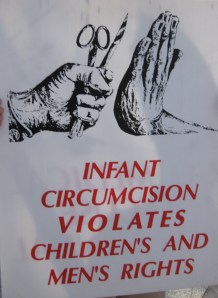
Do medical students have to assist circumcisions?

Dear Dr Pate,

I am a 2nd year medical student that will be starting rotations soon. Coming across your website, I noticed you were an intactivist OB/Gyn. I am also an intactivist and realize there will be many procirc doctors with crazy mindsets. It is expected that there will be issues with doctors when I refuse to help with this operation.

Do you have any advice for me at this point?
Do you get a lot of resistance to your views and how do you deal with it?

I read through your blog briefly, there are some interesting things contained there. Thank You!


Dear P,

Thanks for writing! You absolutely have the right to refuse to participate in any way of the circumcision process including offering the procedure to new parents when you round on patients, discussing it with interested parents who bring up the topic, consenting parents for the procedure, observing and performing circumcisions. Check out the pamphlet Conscientious Objection to the Performance of Non-therapeutic Circumcision of Children: A guidance for healthcare providers from Doctors Opposing Circumcision. You will likely get some flack, but it is absolutely worth it. I have blogged quite a bit about experiences with my residency program regarding the subject. Senior residents in particular were not happy with my stance given that they then “had to do my work”. Whatever. No one can make you do anything you are morally opposed to. Check out the links on my website for information about intactivist organizations. There are a LOT of resources for you and for the parents you will come in contact with. Thanks for your willingness to stand up for personal autonomy and “do no harm.” Feel free to write again at anytime. Good luck!

Sincerely,

James Pate, MD
http://jamespatemd.com

Considering circumcision?

Circumcision has been a “traditional” procedure in the U.S. for many decades. However, more and more parents are choosing to leave their sons intact in spite of  a great deal of pressure from other family members and/or religious leaders to follow their traditions. Why do these parents refuse? What’s the big deal?

sticker1

Well I could tell you, “Go ahead! It’s just a little skin,” and pad my wallet with the extra money I could make from these “simple” procedures. Or I can speak to you as a father who regrets his decision to have his son circumcised and try to provide you with the information you should know before making this life-altering decision for your son(s).

I have written multiple posts on this subject and am what is known as an “intactivist” — an activist for the preservation of intact genitalia for all minors unless medical necessity (not preference) dictates otherwise. However, that is not the point of this post. I simply desire to give you information so that your decision, whichever it may be, may be fully informed.

choice

If you are interested in finding out more about circumcision I highly recommend the following resources:

Finally, if you are just nervous about how to care for an intact penis, it’s much easier than you think. Check out the following pamphlets on how to care for your infant son and what to expect as he ages.

clean

A Public Apology to My Circumcised Son

A Public Apology to My Circumcised Son is another post I came across while catching up on my break. It was posted 11/21/10 on Peachy Keen Birth Services.

“My Little Buster,” the distraught mother writes, “I’m so sorry. How else do I begin this?… As a parent, there will be a million things you will look back on and think ‘Gee… I wish I would have done that differently…’… But how in the hell do I apologize for having part of your genitals amputated for NO MEDICAL REASON? When you were less than 24 hours old!… So for all of the parenting moments I look back upon, wishing I could re-do, having you circumcised is the only one I have utter remorse for. With much, much love, Your Mommy.”

The post struck a cord in me because I too carry this burden, and I echo the sentiments of this mother.

When my son was born in 1998 — in my former life as a closeted, gay, married, mechanical engineer — my ex-wife and I had little discussion on the matter. I am circumcised, my father is circumcised and her father and brother are circumcised. Why wouldn’t we do to our son what was a norm for our family? We didn’t understand the risks. We didn’t understand the permanent damage that we were condoning. We did not understand the history of circumcision in the U.S. nor its root in puritanical aims to deter masturbation. We were simply uninformed and did not understand the gravity of our decision to circumcise our son.

Now it is too late. We stole that choice from him and his body is permanently altered. I have apologized to him. The tears ran down my cheeks. He has forgiven me but at his young age he cannot comprehend the consequences of that decision. Do not repeat our mistakes. Leave your sons whole as nature/god intended them to be. Allow them the autonomy over their bodies that is rightfully theirs alone. Let’s end this barbaric custom of infant genital mutilation!

– James Pate, MD

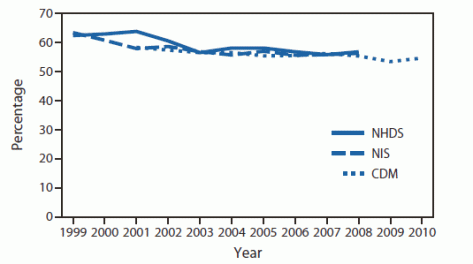
Newborn male infant circumcision declining in U.S. says CDC

Centers for Disease Control and Prevention reports that newborn male circumcision (NMC) is on the decline in the U.S. as evidenced by 3 separate studies: the National Hospital Discharge Survey (NHDS), the Nationwide Inpatient Sample (NIS) and the Charge Data Master (CDM). Incidence of NMC decreased from 62.5% in 1999 to 56.9% in 2008 in NHDS (AAPC = -1.4%; p<0.001), from 63.5% in 1999 to 56.3% in 2008 in NIS (AAPC = -1.2%; p<0.001), and from 58.4% in 2001 to 54.7% in 2010 in CDM (AAPC = -0.75%; p<0.001).

Related posts

The professional imperative for obstetrician-gynecologists to discontinue newborn male circumcision.

The professional imperative for obstetrician-gynecologists to discontinue newborn male circumcision.

Smith JF, Department of Obstetrics and Gynecology, New York Medical College, Westchester Medical Center, Valhalla, USA
Am J Perinatol. 2011 Feb;28(2):125-8. Epub 2010 Aug 10.

Abstract

Newborn male circumcision has been practiced for millennia for a variety of medical, social, religious, and cultural reasons. Indications for routine circumcision remain controversial, with proponents and dissidents arguing their sides vigorously. Popular in the United States, it has persisted in the scope of practice of obstetrics and gynecology, a field specializing in the opposite gender. To excel in women’s reproductive health, we should no longer passively accept or actively maintain this procedure in our specialty. Steps are suggested to remove the residual and improper inclusion of circumcision from the scope of practice of obstetrics and gynecology.

Related posts

End genital mutilation now

Ever hear about genital mutilation? Well it happens every day to babies and children around the world including the USA. According to the 2011 US bill, the Genital Mutilation Prohibition Act submitted to the US Senate and House of Representatives, “genital mutilation” is defined as circumcision, excision, cutting or mutilation of “the whole or any part of the labia majora, labia minora, clitoris, vulva, breasts, nipples, foreskin, glans, testicles, penis, ambiguous genitalia, hermaphroditic genitalia, or genital organs of another person who has not attained the age of 18 years or on any nonconsenting adult.” In line with the 2003 UK Female Genital Mutilation Act that protects girls only, this bill has been written so that all minors may likewise be protected.

Individual communities are also starting to recognize the fact that genital mutilation of children, regardless of sex, is wrong and should be stopped. The Huffington Post, Los Angeles reports that “A proposal to ban the circumcision of male children in San Francisco has been cleared to appear on the November ballot, setting the stage for the nation’s first public vote on what has long been considered a private family matter.” Even a comic book, Foreskin Man, has been created to raise awareness of this long accepted gross violation of the human rights of personal autonomy and self preservation. A pdf of the comic’s first issue can be found here or by clicking on the image above. Unfortunately, the second issue is considered by many to be anti-Semitic, which I do NOT endorse nor desire to be associated with, so I have not provided any other links.

Removing body parts without medical indication and without the consent of the person receiving it is tragic and should be criminalized. This is especially true of the sex organs given that at best, surgery permanently alters cosmetic appearance, sensitivity and sexual function. At worst, surgery can result in horrific disfiguration and/or death. Given these risks I strongly believe that non-medically indicated circumcision should be banned for all minors. Adults who choose to be circumcised for religious or other reasons, such as Jews and Muslims, can surgically alter their bodies after they have reached the age of consent.

David Reimer is one such infant victim whose penis was destroyed by circumcision in 1966. Following the medical advise of Dr John Money, a prominent psychologist and sexologist of the time, David’s parents elected for him to undergo sex reassignment surgery to raise him as a girl. Unfortunately, David never accepted his forced female gender role and began living as a male at the age of 15. He continued to suffer years of severe depression, financial instability, a dissolving marriage and eventually committed suicide in 2005. His tragic story is catalogued in the bestseller biography: “As Nature Made Him: The Boy Who Was Raised as a Girl” by John Colapinto.

Horrific medical complications of male circumcision are NOT a thing of the past. Review of peer reviewed medical journals reveals that present day complications continue to include poor cosmetic outcomes; excessive bleeding; necrosis of the penis and/or surrounding structures; lymphedema; keloid scar formation; skin bridges; buried penis; urethral stenosis, obstruction or fistula; penis shortening; decreased sensation; partial or complete destruction of the penis, amputation and death.

Doctors too should be wary of offering this “service”. Not only are surgical “mishaps” a legal liability but even culturally acceptable outcomes incur an ever increasing risk of malpractice accusation and lawsuit.

In conclusion, it is high time that we recognize infant male circumcision for what it is: a far-too-long accepted tradition of male genital mutilation. All infants and children deserve better than this. Click on one of the banners below to learn more and to find out how you too can help protect children and end genital mutilation now.


Related posts

Are you REALLY SURE you want your OB/GYN to cut your little boy?

Circumcision remains highly marketed at the hospital I mentioned in an earlier post. Although there were at least 3 of us who did not want to perform circumcisions at the beginning of my residency, I remain the only one who has stood my ground. Many residents do not want to do them but do not have a “moral objection” and thus feel they must so as to not shift their work onto other residents. New medical students rotating through labor and delivery are expected to ask new mom’s if they want their sons to be circumcised and to chart it in their notes. There is no discussion about the controversial nature of this procedure nor the option stated that they have the right to opt out. Medical students in particular are less likely to rock the boat because they know that their grade depends on it. It is quite frustrating to me to see how resistant people are to change and how easily people cave-in to peer pressure.

I am especially frustrated that OB/GYN residents and providers continue to feel that they are competent to perform the procedure.The tradition of OB/GYN physicians performing male infant circumcisions began many years ago when they used to deliver babies in the homes of their patients and was born out of convenience; after delivering the baby it seemed appropriate to go ahead and perform the desired circumcision as well. Nowadays the vast majority of deliveries by OB/GYN physicians occur in the hospital with pediatricians and other specialists readily available so convenience is no longer an valid argument. Moreover, OB/GYN residents in general receive scant education in the anatomy and pathophysiology of the penis. Those that choose to perform circumcisions are essentially performing the “simple” procedure without the associated medical knowledge required of all other surgical procedures. And unlike other surgical procedures, the postoperative follow-up and management of complications are performed by pediatricians and other specialists instead of the OB/GYNs who performed them.

A recent article by Dr Brian Le, MD found that while the majority of 27 respondent obstetric-gynecology residents “planned to perform neonatal circumcision when in practice, 44% had no formal training in circumcision and most were comfortable performing routine neonatal circumcision. Overall respondents were less comfortable evaluating whether the a newborn penis could undergo circumcision safely. When presented with 10 pictures of penises and asked to determine whether the neonate should undergo circumcision, 0% of respondents correctly identified all contraindications to neonatal circumcision with an average of 42% of contraindications identified correctly.” (Le B. Mickelson J. Gossett D. Kim D. Stoltz RS. York S. Sharma V. Maizels M. Residency training in neonatal circumcision: a pilot study and needs assessment. Journal of Urology. 184(4 Suppl):1754-7, 2010 Oct.)

I recently performed a Medline Ovid search (looking for primary literature) and found that while there are over 50,000 articles in OB/GYN’s two most respected journals — Obstetrics & Gynecology (aka the Green Journal) and the American Journal of Obstetrics & Gynecology (aka the Gray Journal) — only 43 of these articles address male circumcision. Thus OB/GYN physicians write only 1.1% of the articles relating to male circumcision and represent only 0.076% of the articles they produce. Finally, the American Congress of Obstetricians & Gynecologists (ACOG) continues to reject exhibition of circumcision dissident materials by Intact America at their national conferences because ethical consequences of this procedure are apparently “beyond the scope of the practice of obstetrics and gynecology.”

In summary, while  OB/GYN physicians have a long tradition of performing male infant circumcision and many continue to be more than happy to take a whack at infant penises, there is mounting evidence that they are deficient in the medical knowledge required to do so safely, they are uninterested in learning how to improve their skills and they do not contribute to respected literature to perfect techniques. Are you REALLY SURE you want your OB/GYN to cut your little boy?

Related posts

Doctor and hospital sued for circumcision

Doctors may think that parental consent is all they need to surgically modify the genitals of infant boys but they can still be held liable for malpractice when those little boys grow up. Leave our penises alone and end circumcision now!

Related posts