Tag Archives: Medicine

Posts that relate to medicine in some way.

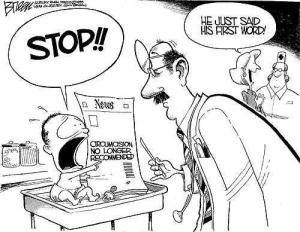
Say NO to infant male circumcision!

Newborn male circumcision is the most common surgical procedure performed in the U.S. Many people believe that there are tangible health benefits to male circumcision but, the truth is no medical society in the world recommends it. In fact, the American Medical Association calls the surgery “non-therapeutic.” What’s worse, over 100 babies die as a result of complications from circumcision in the U.S. each year.

The Centers for Disease Control (CDC) is developing public health recommendations for the U.S. on male circumcision – ignoring the serious risks such as hemorrhage, infection, surgical mishap, and death – in favor of highly debatable and inconclusive research.

The CDC is the foremost expert on public health in our country and, as such, has a responsibility to share the truth about circumcision.

I just took action, signing a petition to the CDC, demanding the organization release a truthful statement on the harms and risks of circumcision.

If you believe as I do, that we should protect newborn babies from harmful and unnecessary surgery, then say NO to infant male circumcision!

Related posts

DSM-5 pathologizes gender variance

The much anticipated 5th edition of the Diagnostic and Statistical Manual of Mental Disorders (DSM-5) by the renown American Psychiatric Association (APA) continues its misguided tradition of pathologizing gender variance. And they have newly expanded the patient base by including intersex individuals who reject their sex of rearing. Mounting evidence continues to demonstrate that gender is hardwired into our brains at a very early age. Indeed most children know their gender identity by age three and adamantly attest to it; no amount of social pressure, environmental factors or psychiatric persuasion can alter this. For individuals whose bodies do not match their gender identities, the only “cure” (normal variation is not disordered and thus does not necessitate cure) is gender reassignment either by physical presentation alone or aided by hormones and/or surgical modification.

According to the APA, “For a mental or psychiatric condition to be considered a psychiatric disorder, it must either regularly cause subjective distress, or regularly be associated with some generalized impairment in social effectiveness or functioning.” Thus in 1973 the APA concluded that “Clearly homosexuality, per se, does not meet the requirements for a psychiatric disorder since, as noted above, many homosexuals are quite satisfied with their sexual orientation and demonstrate no generalized impairment in social effectiveness or functioning.” It is baffling to me how these same conclusions do not apply to gender variance. Both the homosexual and the gender variant are capable of living full rich lives; only they who deny their inner truth and they who are socially tormented for revealing it are so impaired.

And why include the intersexed? After being surgically modified as infants and subsequently forced into living within the socially imposed system of binary gender roles these individuals are somehow disordered for rejecting this suppression? Apparently the medical community who altered them and inaccurately chose their sex of rearing cannot be at fault. What a travesty it is that the medical community continues to rubber stamp society’s aversion to gender minorities by pronouncing them disordered and thus justifying their mistreatment.

Another pregnant man steps forward

Scott Moore and his husband, Thomas, have decided to follow in the footsteps of Thomas Beatie and Ruben Coronado by going public about Scott’s very much wanted pregnancy and impending delivery in order to raise awareness.

While pregnancy among trans men actually occurs with some frequency it has only recently been brought to public attention. And unfortunately the medical community is often just as startled, befuddled and prejudiced as everyone else.

In the article linked above Scott speaks to the difficulty he had obtaining appropriate prenatal care: “We didn’t want everyone to be shocked when a man turns up to give birth. We found it very difficult to get a doctor and midwife at first. It was hard when people didn’t want to treat me… No pregnant person should be denied healthcare just because they are a man.”

Now granted, a portion of the hesitation Scott encountered in finding a provider was likely related to the lack of established treatment guidelines for pregnant trans men, the inherently increased risks to both father and fetus and the medical-legal liability to be assumed by the would-be provider. Even the standards of care published by the renown World Professional Association for Transgender Health (WPATH) are silent on this issue. But the fact remains that few providers make the effort to educate themselves regarding the medical needs of individuals with atypical gender experience and there has yet to be published even one case report in the Medline (Ovid) primary literature database regarding trans men and pregnancy. Clearly medical providers have a long way to go in meeting the needs of this neglected population.

So what should a trans man considering pregnancy do? First of all, do your research early on and find a provider before you get pregnant. Second, testosterone should be discontinued at least 6 weeks prior to pregnancy in order to prevent its deleterious effects on a potentially female fetus. Elevated levels of androgens like testosterone can masculinize external female genitalia as well as brains with potential social, sexual and gender identity consequences. In the event that an inadvertent pregnancy occurs, testosterone should be discontinued immediately if termination is not desired.

For some teens, puberty brings unexpected changes

recent article published on CNN discusses the lives of two teens in Palestine raised as girls but transformed by puberty into boys. These teens most likely have a condition called 5-alpha-reductase deficiency (5-ARD), one of several intersex conditions (disorders of sex development) that alters the masculinization of XY fetuses before they are born. Unfortunately, the article uses outdated words and phrases such as “pseudohermaphrodism” and “sex-change operations” that should no longer be used because they are offensive. However it does raise awareness and give face to a group of people who are usually hidden away.

All fetuses have the same internal and external genitalia until about 8 weeks of gestation. Then various hormones act to differentiate the sexes by developing some parts and regressing others. But there are many steps involved and DNA mutations can modify this outcome. I suspect that Caster Semenya, the recently contested 2009 gold medal winner of the 800 meter race at the World Athletics Championships, has androgen insensitivity syndrome (AIS). If this is so, her XY chromosomes and testes were unable to masculinize her body as it formed; a defective hormone receptor prevents her body from responding appropriately to the male hormones it produces. However, her receptors may be only partially impaired and thus give her, in some people’s view, an unfair advantage over her competitors. The allegations, the subsequent gender verification studies and the fallout therefrom continue to embroil her in international controversy. But what makes a woman a woman? If she isn’t a woman than what is she? She certainly isn’t a man.

The Palestinian teens discussed in the article have a different mutation. Like Caster, they probably have XY chromosomes, testes and appeared just like any other girl when they were born. Yet while their hormone receptors work, they lack the enzyme needed to convert testosterone into its more powerful form, dihydrotestosterone (DHT). Their bodies appeared female before puberty because the amount of testosterone produced was insufficient to make up for the absent DHT. After puberty began their testosterone levels went through the roof just like every other adolescent boy. This brought along the changes the go with it including facial hair, deeping voice and musculoskeletal changes. Their clitorises probably enlarged significantly just as penises do. But do these teens really feel that they are now men or do they still feel that they girls inside of bodies that have betrayed them?

“Only my appearance, my haircut and clothing, makes me look like a boy,” Ahmed says, gesturing with his hands across his face. “Inside, I am like a female. I am a girl.”

Why do we care if Caster and these teens are men or women, one or the other? Is it right for society to force them to change to uphold the myth of binary gender? When you really think about it, no one fits the stereotype completely; no one is or every was the ideal man or the ideal woman. They are only fantasies. Instead we are all composites, not one of us pure in form. We exist somewhere in the middle leaning this way and that in varying degrees depending on which attribute we consider. Gender is so much more than the 2 little check boxes “male” and “female.” Maybe someday we will learn to allow each other the space to simply be who we are. A world without labels and boxes, without simplification and alteration. We will finally see the world as it already is.

IAAF offers to pay for Caster Semenya’s gender surgery if she fails verification test – Telegraph

IAAF offers to pay for Caster Semenya’s gender surgery if she fails verification test – Telegraph. This article was recently addressed in the Organisation Intersex International (OII) Forum and someone asserted that the reason why doctors remove testicles from women with androgen insensitivity syndrome (AIS) is because we want to prevent women from having them. So, I did a little research and this is what I found out:

There really isn’t a conspiracy to prevent women from having testes. The issue is that mammalian testes need to be cooler than core body temperature; thus testes have evolved to hang outside of the body in scrotums. Internalized testes are a cancer risk for both men and women. And the risk of cancer is greater in women with AIS than in men with undescended testes (UDT).

According to HM Wood (1):

  • The incidence of testicular cancer in men is 0.9 to 7.8 per 100,000 men per year
  • 1.1 to 1.6% of boys have unilateral or bilateral undescended testes
  • Among men with testicular cancer, 5-10% have had a history of UDT
  • Men with a history of UDT have 2.75 to 8 times the risk of testicular cancer compared to men who don’t; the risk is even higher in men with bilateral UDT, associated genitourinary anomalies, or late (after age 10-12 years) or uncorrected UDT
  • Orchiopexy (repositioning testes outside the body) by age 10 to 12 years results in a 2 to 6-fold decrease in relative risk of cancer compared with orchiopexy after age 12 years or no orchiopexy

According to SJ Robboy (2):

  • The incidence of complete AIS is 1 in 20,000 live births
  • There is a risk for malignancy in AIS gonads owing to the occurrence of germ cell tumors. The cumulative risk for a germ cell tumor is greater than 30% by 50 years of age
  • The risk of malignancy in patients with testicular feminisation is only 4% by the age of 25 years, but reaches 33% by 50 years

Thus, women CAN have testes, but they should be removed if they aren’t located in a scrotum.

References:
(1) Wood HM. Elder JS. Cryptorchidism and testicular cancer: separating fact from fiction. Journal of Urology. 181(2):452-61, 2009 Feb.
(2) Robboy SJ. Jaubert F. Neoplasms and pathology of sexual developmental disorders (intersex). Pathology. 39(1):147-63, 2007 Feb.

Talk to your kids about sex

Alice Park reports on Time.com that parents are talking with their kids too little too late according to a 2009 study in Pediatrics. In fact, approximately 40% will have sex before their parents finally bring up the subject of “the birds and the bees”. It certainly was true in my case.

I can remember being a teenager and one ordinary day my mother taking up the subject of sex. She just kept going on and on about how important it was to stay a virgin until marriage in spite of my protests “I know, Mom” and attempts to change the subject. Eventually I tired of her lecture and finally blurted out, “Mom, just stop. I’m not a virgin.” I still remember the look of shock in her eyes as she muttered, “I’m so disappointed in you” before walking away.

Frankly, I was disappointed in her. Waiting until your kid is 16 before having this conversation is way too long. I remember kids talking about sex on the playground in elementary school, don’t you? Kids aren’t dumb and kids are curious.

I took a different approach with my kids. Beginning in their toddler years I began addressing the subject of body parts using their correct anatomic names — a penis is not a “peepee” or “junk” nor is a vagina “private parts”. Eyes are eyes and noses are noses, why should sexual organs be any different? As their minds developed I added more to their knowledge, always addressing the subject in a matter of fact way and answering all of their questions. If a child is able to comprehend and formulate a question then s/he is mature enough to receive an answer.

I recently had a conversation with my son who is 11. He told me that now that he is in 6th grade he has to have health and sex education. He seemed rather annoyed by the idea and said, “I really don’t know why I have to learn about it in school, you’ve already taught me all about it.” I just listened and smiled.